* Akousmata
The Acousmatic Lectures are a laboratory for investigating phenomena that are directly related to voice and its research-based, artistic, and social dimensions. The term Acousmatics references a Pythagorean tradition according to which only Pythagoras’s most devoted students were allowed to see the master during his lectures. By contrast, newcomers were made to sit before a curtain concealing the master’s physiognomy. Those students were therefore left without any visual information and had to try to follow the lectures solely by attentive listening.[1]
The Acousmatic Lectures are a series of discursive, acoustic undertakings that take the Pythagorean acousmatic model as a starting point for constituting a new type of interaction between speaker and listener. The conveying of information between speaker and audience as well as the surrounding context is stripped of all forms of supplementary visual aids; the situation is conducted through acoustic means alone—through speaking and listening. No microphones and/or amplifiers are used during the Acousmatic Lectures. In this way, the natural volume of the speaker’s voice and its tonality are better able to convey his or her physical presence. Here, the voice is understood as an acoustic space that is definable in myriad ways, where physical and affective communicational idiosyncrasies can be transformed. Emphasis is placed on the dialectical investigation of abstract linguistic information and the voice’s own sensory acoustic information and confronts the audience with the decision that is central to the idea behind the Acousmatic Lectures: that of listening.
A simple but rigorous setting requires participants to call on all of their possible auditory abilities that help define both the physical presence of the other as well as the surrounding space. The lecture functions in part as a guiding element that describes the space acoustically, binding together the physical, spatial presence of participants. But the lecture is, of course, also the conveyor of cognitive information. As a result, the process of listening branches out in various directions, requiring one to constantly redefine and choose what to listen to.
The speakers are academics and scholars who talk about their specific areas of expertise. The intention is to observe what impacts the acousmatic settings have on participants, and specifically without the influence of any artistic or aesthetic sensory effects. In the Acousmatic Lectures held thus far, a performative character has been observed that condenses the classic academic lecture scenario into an acoustic experience that functions both informatively —on a linguistic level— as well as in an acoustically qualitative way —on the level of the voice as instrument (“reduced listening”[2])— and is capable of transforming situations, content, and space. These aspects are made legible through the ways in which the acoustic characteristics of the voice interact with the surrounding space. As such, they might be experienced as a means for determining the interaction between and transfer of linguistic and affective sensory information. Therefore the acousmatic setting highlights the performative aspects of the lecture through the removal of all secondary visual information.
Procedure and Conditions
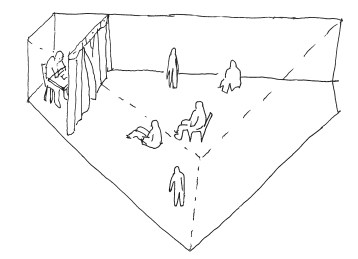
It is the artist’s intention —with an almost purist attitude from the initial idea to the realization of the Acousmatic Lecture— to preserve the clearly defined diagram of the setting. To this end, a number of basic conditions have been defined for realizing the Acousmatic Lectures:
– The space selected for the Acousmatic Lecture is to be large enough to accommodate a minimum of twenty and a maximum of forty people. This allows the speaker to present his or her lecture without the use of a microphone and amplifier.
– A curtain will cordon off roughly a quarter of the overall space. Both areas are to have separate entrances to ensure that audience and speaker do not come into contact prior to the lecture.
– The curtain should be placed in the room so that the curtain is perceived as an object.
– The lecture will not be introduced or moderated. The host will not present him or herself to the audience either before or after the lecture. The Acousmatic Lecture starts the moment the speaker begins and ends when the speakers stops. No one except the organizer and the speaker know the exact starting time of the lecture and how long it will last.
– There will be no applause or closing remarks. The silence following the lecture will slowly dissipate as the audience begins speaking and the situation gradually normalizes.
– The speaker must wait at least fifteen minutes following the end of his lecture to greet the audience.
– The lecture is recorded on audio and added to the Acousmatic Lecture online archive. The audio documentation is not a substitute for the Acousmatic Lecture itself.
[1] Kurt von Fritz, Mathematiker und Akusmatiker bei den alten Pythagoreern (Munich: Verlag der Bayerischen Akademie der Wissenschaften, 1960).
[2] Schaeffer distinguish between ordinary listening and repeated listening. The former is divided into the four categories listening, hearing, attending and understanding. Reduced listening is achieved by repeated listening, which enables the listener to focus on the intrinsic features of a sound, disconnected from its context. Reduced listening is a tool for investigation and for shifting listening attention intentionally, from the contextual to the inherent features of sound. Criticism of reduced listening points out the difficulty of ignoring the contextual associations of a sound. Smalley (1997) points out certain problems with reduced listening: after one has perceived very fine intrinsic audible features in a sound, it may become very difficult to regain a normal listening mode, with all references to the outside world are in place. Low- level investigation, such as focusing entirely on the background at the cost of the foreground, tends to magnify details of minor importance. When practicing a musical instrument, one practices reduced listening. http://www.ems-network.org/ems15/book/node22.html
Mario Asef is an architect and conceptual artist based in Berlin. His projects address both ecological and socio-political issues and confront questions related to their spatial and linguistic representability. His works are divided into three methodological categories: the field of language as a structurer of physical space, the field of history and writing about history as a construction of mediated reality from a post-colonial point of view, and the scientific field of transdisciplinary enquiry and exchange. He is co-editor of “Akusmatik als Labor: Kultur-Kunst-Medien.” He cooperates with Amarodrom e.V. an intercultural youth self-organization of Rom*nja and non-Rom*nja and is chairman of Errant Sound e.V. a project space for sound art in Berlin and is co-director of Dystopie Sound Art Festival.
(D)
* Akusmata
Acousmatic Lectures ist ein Labor zur Untersuchung von Phänomenen, die unmittelbar mit akustischen Informationen und ihrer wissenschaftlichen, künstlerischen und gesellschaftspolitischen Dimension in Verbindung stehen. Der Begriff Akusmatik bezieht sich auf eine Tradition der Schule des Pythagoras, wonach es nur seinen engsten Schülern erlaubt war, Pythagoras während seiner Vorlesungen zu sehen. Im Gegenteil: Die nicht Eingeweihten sollten vor einen Vorhang sitzen, der die Physiognomie des Meisters verhüllte. So blieben diese ohne jegliche visuelle Information und mussten allein durch intensives Zuhören versuchen, die Lesungen zu verstehen.[1]
Die Acousmatic Lectures sind eine Reihe von diskursiven akustischen Erlebnissen, die das pythagoreische akusmatische Modell als Ausgangspunkt verwenden, um eine neue Weise der Interaktion zwischen Redner und Zuhörer zu konstituieren. Dem Informationsaustausch zwischen Redner und Publikum und deren Umgebung werden alle Arten von visueller Unterstützung verweigert; die Situation wird nur akustisch geleitet – durch Sprechen und Zuhören (reduziertes Hören [2]). In den Acousmatic Lectures werden keine Mikrofone und/oder Verstärker verwendet. Auf diese Weise soll die physische Präsenz des Sprechers durch die natürliche Lautstärke seiner Stimme und ihres Klanges besser zum Ausdruck kommen. Hier wird die Stimme als ein vielseitig definierbarer akustischer Raum verstanden, in dem physikalische und affektive Kommunikationsgewohnheiten transformiert werden können. Dabei wird die dialektische Auseinandersetzung mit abstrakten sprachlichen Informationen und sensorischen akustischen Informationen der Stimme unterstrichen und man wird mit einer für die Idee der Acousmatic Lectures zentralen Entscheidung konfrontiert: mit der des Zuhörens.
Ein einfaches, aber strenges Setting fordert von den Teilnehmern, alle ihre möglichen auditiven Fähigkeiten aufzubringen, die sowohl die physische Präsenz des anderen als auch den umgebenden Raum zu definieren helfen. Die Lecture fungiert zum Teil als leitendes Element, das den Raum akustisch beschreibt und die physikalisch-räumliche Präsenz der Teilnehmer bindet. Aber die Lecture ist selbstverständlich auch Trägerin von kognitiven Informationen. Im Ergebnis spaltet sich der Prozess des Hörens in mehrere Zweige und verlangt eine ständige Neudefinierung und Entscheidung des Zuhörens.
Die Vortragenden sind Wissenschaftler, die über ihr fachspezifisches Gebiet berichten. Damit soll versucht werden, die Wirkung des akusmatischen Settings zu beobachten, und zwar ohne den Einfluss von sensorischen Effekten künstlerischer und ästhetischer Natur. In den bis jetzt realisierten Acousmatic Lectures wurde ein performativer Charakter beobachtet, der die akademisch-klassische Vortragssituation in eine akustische Erfahrung konzentriert, die sowohl informativ – auf sprachlicher Ebene – als auch akustisch-qualitativ – auf der Ebene der Stimme als Instrument – fungiert und in der Lage ist, Situationen, Inhalte und Raum zu transformieren. Diese Aspekte werden durch die akustischen Eigenschaften der Stimme in direkter Interaktion mit dem umgebenden Raum lesbar. Sie könnten in dieser Weise zur Feststellung der Wechselwirkung zwischen sprachlicher und sensorisch-affektiver Informationsvermittlung erfahrbar werden.
Das akusmatische Setting hebt die performativen Aspekte des Vortrages durch die Entfernung aller sekundären visuellen Informationen hervor. Die Situation ist jedoch nicht als verfehlt definiert, sodass man sich als Zuhörer der Lecture im Entscheidungszwang befindet, die Situation selbst zu definieren.
Ablauf und Bedingungen
Es ist Absicht des Künstlers, mit einer fast puristischen Haltung von der Konzeption bis zur Realisierung der Acousmatic Lecture das klar definierte Diagramm des Settings zu bewahren. Zu diesem Zweck wurde für die Realisierung der Acousmatic Lectures eine Reihe von grundlegenden Bedingungen definiert:
– Der Raum, der für die Realisierung der Acousmatic Lecture gewählt wird, soll groß genug sein, um ein Minimum von 20 und ein Maximum von 40 Personen aufnehmen zu können. Dies erlaubt dem Sprecher, seinen Vortrag ohne die Implementierung von Mikrofon und Verstärker zu halten.
– Ein Vorhang wird den Raum in ca. ¼ der gesamten Größe teilen. Beide Bereiche sollten separate Eingänge haben, um sicherzustellen, dass sowohl das Publikum als auch der Sprecher vor der Vorlesung nicht miteinander in Kontakt kommen.
– Der Vorhang soll im Raum platziert werden, sodass der Vorhang als Objekt wahrgenommen werden kann.
– Es wird keine Präsentation oder Moderation des Vortrags geben. Der Gastgeber wird das Publikum weder vor noch nach dem Vortrag begrüßen. Die Acousmatic Lecture startet in dem Moment, wenn der Vortragende zu reden beginnt und endet, wenn dieser mit der Rede aufhört. Niemand außer dem Veranstalter und dem Vortragenden wissen, zu welchem Zeitpunkt der Vortrag beginnt und wie lange er dauern wird.
– Es wird keinen Applaus bzw. kein Schlusswort geben. Die Stille nach dem Vortrag wird langsam verschwinden, sobald das Publikum zu sprechen beginnt und sich damit die Situation schrittweise normalisiert.
– Der Sprecher hat die Möglichkeit, frühestens 15 Minuten nach Beendigung seines Vortrages dem Publikum zu begegnen.
– Der Vortrag wird als Audio dokumentiert und zum Acousmatic Lecture Online Archiv hinzugefügt. Die Audiodokumentation kann in keiner Weise die Acousmatic Lecture selbst ersetzen.
[1] Kurt von Fritz: Mathematiker und Akusmatiker bei den alten Pythagoreern. Verlag der Bayerischen Akademie der Wissenschaften, München 1960
[2] Schaeffer unterscheidet zwischen gewöhnlichem Zuhören und wiederholtem Zuhören. Ersteres wird in die vier Kategorien Hören, Zuhören, Zuhören und Verstehen unterteilt. Reduziertes Hören wird durch wiederholtes Hören erreicht, das es dem Hörer ermöglicht, sich auf die intrinsischen Merkmale eines Klangs zu konzentrieren, losgelöst von seinem Kontext. Das reduzierte Hören ist ein Instrument zur Untersuchung und zur bewussten Verlagerung der Aufmerksamkeit des Hörers vom Kontext auf die dem Klang innewohnenden Merkmale. Kritiker des reduzierten Hörens weisen auf die Schwierigkeit hin, die kontextuellen Assoziationen eines Klangs zu ignorieren. Smalley (1997) weist auf bestimmte Probleme beim reduzierten Hören hin: Nachdem man sehr feine intrinsische hörbare Merkmale in einem Klang wahrgenommen hat, kann es sehr schwierig werden, wieder in einen normalen Hörmodus zu gelangen, in dem alle Bezüge zur Außenwelt vorhanden sind. Eine Untersuchung auf niedrigem Niveau, wie z. B. die vollständige Konzentration auf den Hintergrund auf Kosten des Vordergrunds, neigt dazu, Details von geringer Bedeutung zu vergrößern. Wenn man ein Musikinstrument übt, übt man reduziertes Zuhören. http://www.ems-network.org/ems15/book/node22.html
Mario Asef ist ein in Berlin lebender Architekt und Konzeptkünstler. Seine Arbeiten gliedern sich in drei methodische Kategorien: das Feld der Sprache als strukturierendes Element des physischen Raums, das Feld der Geschichte und der Geschichtsschreibung als Konstruktion der vermittelten Wirklichkeit aus postkolonialer Sicht und das wissenschaftliche Feld der transdisziplinären Untersuchung und Austauschs. Er ist Mitherausgeber von “Akusmatik als Labor: Kultur-Kunst-Medien”. Er kooperiert mit Amarodrom e.V. eine interkulturelle Jugendselbstorganisation von Rom*nja und Nicht-Rom*nja und ist Vorsitzender von Errant Sound e.V. ein Projektraum für Klangkunst in Berlin. Er ist Co-Direktor von Dystopie Sound Art Festival.
Interview für w/k Zwischen Wissenschaft & Kunst – Onlıne-Journal
—
Please notify that disclosing, copying, distributing or taking any action in reliance on the contents of this website is prohibited.
All rights reserved © Mario Asef 2014
Please ask the author for more information or booking of an Acousmatic Lecture
Contact / Kontakt: acousmaticlectures(at)gmail.com
 Acousmatic Lectures